
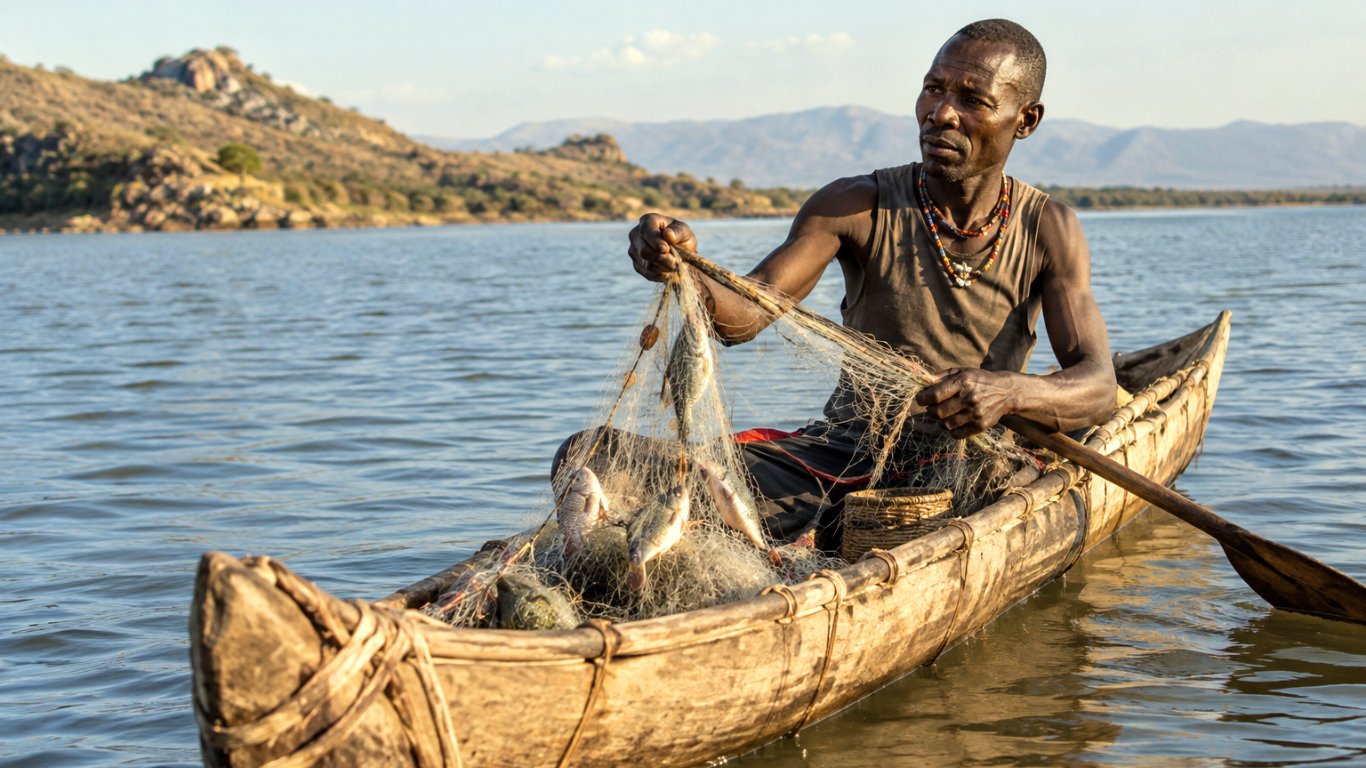
The canoe is called a kaldich. It is built from ambatch wood, a timber so light that a man can carry his boat to the water on one shoulder. The pieces are lashed together with wild sisal. The Il Chamus have been paddling these onto Lake Baringo for generations, catching tilapia and catfish. Everywhere else their language is spoken, across Kenya and northern Tanzania, fish is not regarded as food at all.
Who They Are
The Il Chamus people of Kenya live south and south-east of Lake Baringo, in Baringo County. They are one of the smallest ethnic groups in the country. The 2019 census recorded 32,949; academic work published in 2023 puts the figure at roughly 35,000.
They are also called the Njemps, an anglicisation of En-Jemusi, and both names are in current use. Their language is Maa — the same language family as Maasai and Samburu, placed in the Eastern Nilotic branch. It sits closest to Samburu, with which it shares between 89 and 94 per cent of its vocabulary.
That linguistic closeness makes what follows more striking, not less. Maasai food custom excludes fish, along with wild game and chicken. Researchers working in Kajiado recorded the community’s view that aquatic animals are not fit to eat. The Il Chamus, speaking a sister language a few hundred kilometres north, built their diet and part of their economy around the lake.
Lake Baringo itself may carry their word. One account traces the name to the Il Chamus mparingo, reshaped by colonial pronunciation into the spelling now on every map of the Rift Valley.
A History Worth Knowing
Accounts of Il Chamus origins differ, and the honest version says so. One tradition holds that they descend from a Samburu section, the Il-Doigolo, who moved south around the middle of the eighteenth century. Another holds that they are what remained of Il-Oikop or Il-Kwavi Maasai after defeat in the nineteenth-century Maasai civil wars. Survivors settled at Baringo and became farmers. A third strand of oral tradition names Laikipia as the cradle land, with dispersal following the wider Maasai movements of the late nineteenth century.
What the record agrees on is the sequence of livelihoods. The Il Chamus economy moved from foraging and fishing into a sophisticated irrigation system. Pastoralism came later, under the influence of Samburu incomers and neighbouring Maasai. By the nineteenth century they were running large-scale irrigated agriculture on the floodplains. Furrows drawn off the rivers fed crops in a landscape that receives too little rain to farm any other way.
This made Baringo an oasis in the fullest commercial sense. A settled, grain-producing community in the middle of arid pastoral country was a place where caravans could restock, and the Il Chamus fed them.
Colonial administration reached them in 1900, when the British established a post at Loiminange, now Kiserian. State protection settled grazing disputes in Il Chamus favour, and the British went on to use them as allies in punitive raids against neighbours. The cattle that came out of those raids pushed the community further toward herding. It is a pastoral identity acquired partly through colonial alliance, not inherited from the start.
The neighbours remember it too. Tension with the Pokot and the Tugen runs back to territorial competition in the early twentieth century and has never fully settled. On 27 March 2005, Pokot fighters attacked Il Chamus villages; the killing and displacement continued over several weeks. National Police Reservists were only established among the Il Chamus in 2013, numbering around fifty men by 2019.
Language & Identity
The Il Chamus people of Kenya speak a Maa language of the Eastern Nilotic branch. It is not a Kalenjin language, and it has no click consonants — two claims that circulate in popular write-ups and are simply wrong.
Its nearest relative is Samburu, at 89 to 94 per cent shared vocabulary, which places Il Chamus firmly inside the Maa-speaking world alongside the Maasai and the Samburu. Kenya has only three Maa-speaking peoples, and this is the smallest of them.
The language carries the anomaly in its own lexicon. A Maa vocabulary with words for canoe timber, paddle wood and lake fish records a decision this community made and its relatives did not. They lived by it long enough for the words to settle.
Culture, Customs & Celebrations
Authority among the Il Chamus has traditionally rested with a council of elders, who settled disputes, made sacrifices and conducted the community’s ceremonies. This is the Maa pattern, and it sits alongside the age-based organisation the community shares with its larger relatives.
Dress marked position precisely. Women wore beaded skirts; men wore copper earrings; children had wooden earplugs fitted at around the age of six. Beadwork remains the community’s most visible art, worked in the colour and geometry common across Maa-speaking peoples but read locally for who is wearing it and why.
The craft that is theirs alone is the boat. Building a kaldich means selecting ambatch, binding it with wild sisal, and cutting a paddle from kaemai wood. No other Maa-speaking community had reason to develop that knowledge. It exists because of one lake.
Ceremony among the Il Chamus follows the rites of passage that structure Maa life: birth, initiation into adulthood, marriage, death. Beyond that broad frame, the detailed ceremonial record is thinner than popular articles imply. A good deal of what circulates online about Il Chamus ritual does not survive checking. Invented deity names and vocabulary borrowed from unrelated communities turn up repeatedly, and this profile leaves them out.
Livelihood & the Land
Three livelihoods have carried the Il Chamus people of Kenya, and all three are under pressure at once. Irrigated farming came first and still matters — maize and other crops on plots watered from the rivers that feed Lake Baringo. Fishing runs alongside it, tilapia and catfish taken from ambatch canoes and sold locally as well as eaten. Livestock came last and, until recently, mattered most for status.
That last pillar is giving way. Since the early 2000s the Il Chamus livestock economy has been declining at a rate researchers describe as unprecedented for the community. The causes stack. Invasive plants have overrun the grazing, chief among them Prosopis juliflora, known locally as mathenge, which has spread across large areas of the Lake Baringo basin. Repeated drought compounds it, alongside a generational shift toward farming and wage work.
Then there is the water. Lake Baringo’s surface area grew by around 60 per cent between 2013 and 2020, reaching 270 square kilometres by May 2020 after months of exceptional rain. Homes, farms, businesses and entire islands went under. By that May the freshwater Baringo and the alkaline Bogoria had closed from twenty kilometres apart to thirteen, raising the prospect of two chemically incompatible lakes merging. The lake that made this community possible is now taking back the ground it farms.
Belief & Spiritual Life
Il Chamus religious life belongs to the Maa world. Enkai, also rendered Eng’ai, is the creator and the source of rain. Among Maa-speaking peoples the same word carries both meanings. That tells you most of what you need to know about a religion formed in dry country.
The council of elders held the ritual functions: offering sacrifices, conducting ceremonies, marking the passages that moved people between life stages. Christianity has a presence across Baringo County today, as it does throughout the Rift Valley, and coexists with older observance.
Beyond this, the documented record of Il Chamus spiritual practice is limited. Detailed claims about specific shrines, spirit categories and sacred groves appear in popular sources using vocabulary borrowed from entirely unrelated Kenyan communities, and they are not repeated here.
Food & Drink
Fish is the dish that separates this community from its relatives. Tilapia and catfish from Lake Baringo are grilled, boiled or smoked, and smoking doubles as the preservation method that lets a catch travel to market. Around the fish sits the food of a farming and herding people. Maize, millet and beans come from irrigated plots; milk and occasional meat from cattle, goats and sheep. Honey was gathered from tree trunks. Meals are shared. In a community of this size, eating together is not a quaint tradition so much as the ordinary shape of a day.
The Traveller’s Encounter
Lake Baringo is one of Kenya’s best freshwater birding destinations, and the boat trip is the way in. Local Il Chamus boatmen run trips out to see hippo, crocodile, fish eagles and the cliff-nesting species that draw birders to the escarpment. Hiring a community boatman rather than a lodge tender puts the fee in the right place.
The most interesting thing to visit here is Ruko Community Conservancy, set up jointly by the Il Chamus and the Pokot. Those are the same two communities whose conflict cost lives in 2005. Ruko is where a small herd of Rothschild’s giraffes ended up stranded on Longicharo Island as the lake rose, with the water climbing roughly six inches a day. In December 2020 rangers began floating them off on a custom steel barge, built by community members and buoyed with empty drums. They trained the giraffes to walk aboard using mangoes rather than sedating them. Fewer than 3,000 Rothschild’s giraffes remain in Africa.
For visitors, two things are worth knowing. Flooding has damaged infrastructure around the lake repeatedly since 2020, so confirm access and accommodation before travelling rather than on arrival. And the Il Chamus people of Kenya are a community of roughly 33,000 in a country of more than fifty million. At that scale, every visitor’s behaviour gets noticed. Ask before photographing, buy from the people who made the thing, and take the boat with someone whose family has been on this water for generations.
Today
In 2006, four members of this community took the Kenyan government to court. They argued that the Il Chamus, too small to elect anyone in a constituency dominated by larger neighbours, had been denied representation in the National Assembly altogether. On 18 December that year the High Court agreed, declaring that the Il Chamus constituted a special interest the Electoral Commission was required to account for.
The judgment was a landmark in Kenyan minority rights. Nearly two decades later, the community still has no constituency of its own. Researchers have described the outcome as a victory in theory and a loss in practice. That is where the Il Chamus stand. They are distinctive enough to be a genuine anomaly in East African ethnography. Being right in court changed very little. The canoes still go out.
For more of Kenya’s communities and the landscapes that made them, explore the Safiri Kenya blog on Kenya Geographic.

Comment (0)