
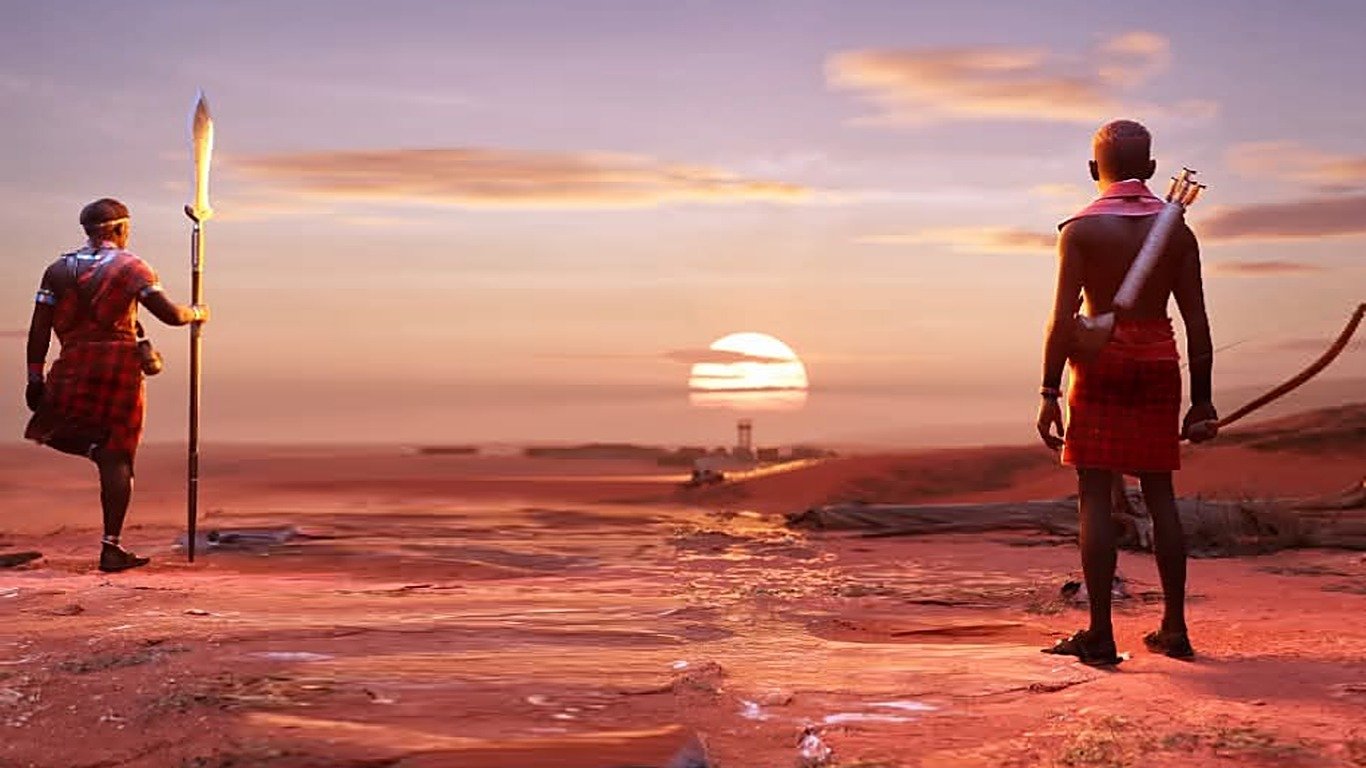
Somewhere on the internet right now, a warrior is standing perfectly still. One foot planted on red earth. The other tucked against his knee. A spear within reach. Eyes on the horizon. Beneath the clip, the comments pile up. Broken animation. Glitch. AI error. Did anyone test this game? Thousands of people, across continents, looked at that warrior and saw a mistake. Not one of them knew they were looking at one of the oldest pieces of body knowledge in East Africa — a posture Maasai herders have carried across the savanna for centuries, unexplained, unphotographed for its meaning, and entirely unknown to the world that thinks it knows Kenya.
That confusion is the story. Because it reveals two uncomfortable truths at once. The world has consumed Kenya’s image for over a century without ever reading it. And nothing corrects that faster than a Kenyan telling a Kenyan story without apology.
The Posture the Cameras Never Asked About
Every traveller who has passed through the Maasai Mara has seen it. Few have asked about it. A moran stands at the edge of the grassland, balanced on one leg, motionless, sometimes for what seems like hours. Tourists photograph the silhouette at sunset. The image sells calendars, postcards, safari brochures. It has become one of the most reproduced pictures of Africa on earth. And yet almost nobody outside the community knows why he stands that way.
The answer is a small masterpiece of practical intelligence. A moran’s day is long. He walks great distances guarding cattle across open country. His legs tire, and he must rest — but he cannot sit. Sitting means losing the horizon. Losing the horizon means a lion reaches a calf unseen, or raiders cross the tree line unannounced. So the body found a solution. One leg carries all the weight while the other rests completely, foot tucked against the knee, a staff or spear taking part of the load. Minutes later, the legs trade places. He can hold this rhythm for hours, fully upright, fully alert, eyes never leaving the grass.
This is not a pose. It is an answer — worked out across generations of pastoral life, refined until it became instinct, passed down through the body itself. The world photographed it a million times and never once asked the question.
Then a Game Put It on Screen
In Nairobi, a small studio called Kunta Content has spent years building Hiru — a video game following a young Maasai prince across savannas, forests, and deserts to rescue his sister from the poachers who destroyed his clan.
The team, led by Kenyan game producer Dean Gichukie, made one decision that mattered more than any other. They refused to translate the culture into something foreign audiences would find familiar. The landscapes stayed Kenyan. The story stayed rooted. And when the warrior rested between battles, he stood the way a moran actually stands. One leg. Perfect stillness.
Global games had trained their audiences differently. Idle characters shuffle, sway, shift their weight — because somewhere along the way, designers decided that restlessness is what waiting looks like. Whole generations of players absorbed that assumption without noticing they held it. So when early footage of the game spread online, the collision was instant. The warrior’s stillness — the stillness of a man who knows how to wait — read as an error to eyes raised on a different grammar of the body. The bug was never in the game. It was in the observer.
The Correction
What happened next is the part worth studying.
The misreading went viral. So did the correction. Kenyans arrived in the comment sections carrying context. Diaspora voices joined. Travel writers, photographers, and curious gamers traded what they knew. Threads that opened with this animation is broken closed with strangers asking, tell me more about the Maasai.
For a remarkable window — one that first opened in late 2022 and keeps reopening with every fresh wave of footage — Maasai culture in Kenya was being discussed in corners of the internet that had never typed the word Kenya before. Not Kenya the safari brochure. Not Kenya the marathon champions. Kenya as a place with its own physical intelligence — its own way of reading land, distance, and time. The numbers tell their own story. By the studio’s own count, its content has gathered more than seven million impressions — for a game nobody can buy yet.
Sixteen people in a Nairobi studio, now working with nine global partners, reached an audience most national campaigns would envy. And the attention became momentum: Microsoft’s Xbox drew the studio into its Game Camp Africa programme and now cites it among the programme’s proudest outcomes. Safaricom hosted the game’s story at its engineering summit. By early 2026, visitors at Nairobi Design Week were playing Hiru demos themselves — holding the savanna in their own hands.
The game is still in development, targeting release later this year. Before a single copy has sold, one accurate detail — kept against every commercial instinct to smooth it away — has already done all of this.
Is This Another Way to Market Kenya?
Here is the uncomfortable question this episode forces. If one idle animation could teach the world more about Maasai life than decades of tourism campaigns — what exactly have those campaigns been teaching? The honest answer: they taught the world to look, never to read. Kenya’s tourism story has been told in landscapes. The wildebeest crossing. The flamingos. The lion in golden grass. The Maasai appear in that story too — but as image, as silhouette, as the red-cloaked figure at the edge of the frame. The world received the picture and none of the text.
Yet the text is the product. Looking fills a camera roll. Understanding fills a return ticket. A traveller who learns why the warrior stands on one foot has crossed a line that no sunset photograph crosses — from spectator to student of a place. Those are the visitors who come back, who stay longer, who send their friends, who defend Kenya in conversation because they feel they genuinely know it. Our training series coming soon on learnQuest focuses on teaching you to recognise such aspects in product packaging.
The one-legged stance is one sentence in a very long text. That text includes how a coastal fisherman reads the tide. How a Samburu homestead is built to follow the seasons. How funeral songs carry whole genealogies inside their melodies. How a grandmother knows her herbs by smell alone. Almost none of it has been offered to the world at any real scale.
Since the hunting safaris of the early 1900s — when Theodore Roosevelt’s expedition made Kenya the world’s most famous wilderness — we have been selling the cover of the book. A century on, the world still hasn’t been invited past it.
What This Says About Who Tells the Story
The second truth is quieter but larger. The correction did not come from a ministry, an embassy, or an agency. It came from a story — made locally, told plainly, and kept accurate at the exact point where accuracy looked commercially risky. That is what local storytelling does that no imported production can. A foreign studio rendering the Maasai would almost certainly have “fixed” the idle stance, the same way foreign films have flattened Kenyan detail for decades — smoothing the unfamiliar into the expected until nothing true survives the translation. It took storytellers rooted here to know that the strange-looking detail was the treasure. And the internet, for all its noise, rewarded that fidelity.
The controversy became a classroom. The classroom became curiosity. The curiosity became seven million impressions of the kind money famously cannot buy. There is a lesson here for every institution that markets this country: cultural accuracy is not a constraint on reach. It is the source of it. The things about Kenya that feel too specific, too local, too unexplainable — those are precisely the things the world has never seen, and therefore precisely the things it will stop scrolling for.
The Warrior Is Still Standing
The warrior on the savanna has been standing on one foot for centuries, asking nothing of anyone. He was there before Roosevelt’s rifles, before the brochures, before the game. He will be there after all of them. What changed is that, for one viral moment, the world finally asked the question the photographs never prompted: why does he stand that way?
Kenya is full of details like that one — practices the world would mistake for errors because it has never been taught to read them. Every one of them is a door. And every door opened brings someone closer to booking the flight, choosing this country over louder destinations, and arriving ready to read the land rather than merely look at it.
The stories are already here. They have always been here. They are simply waiting for tellers brave enough to leave them exactly as they are. Trust us here at Kenya Geographic to do just that.

Comment (0)