
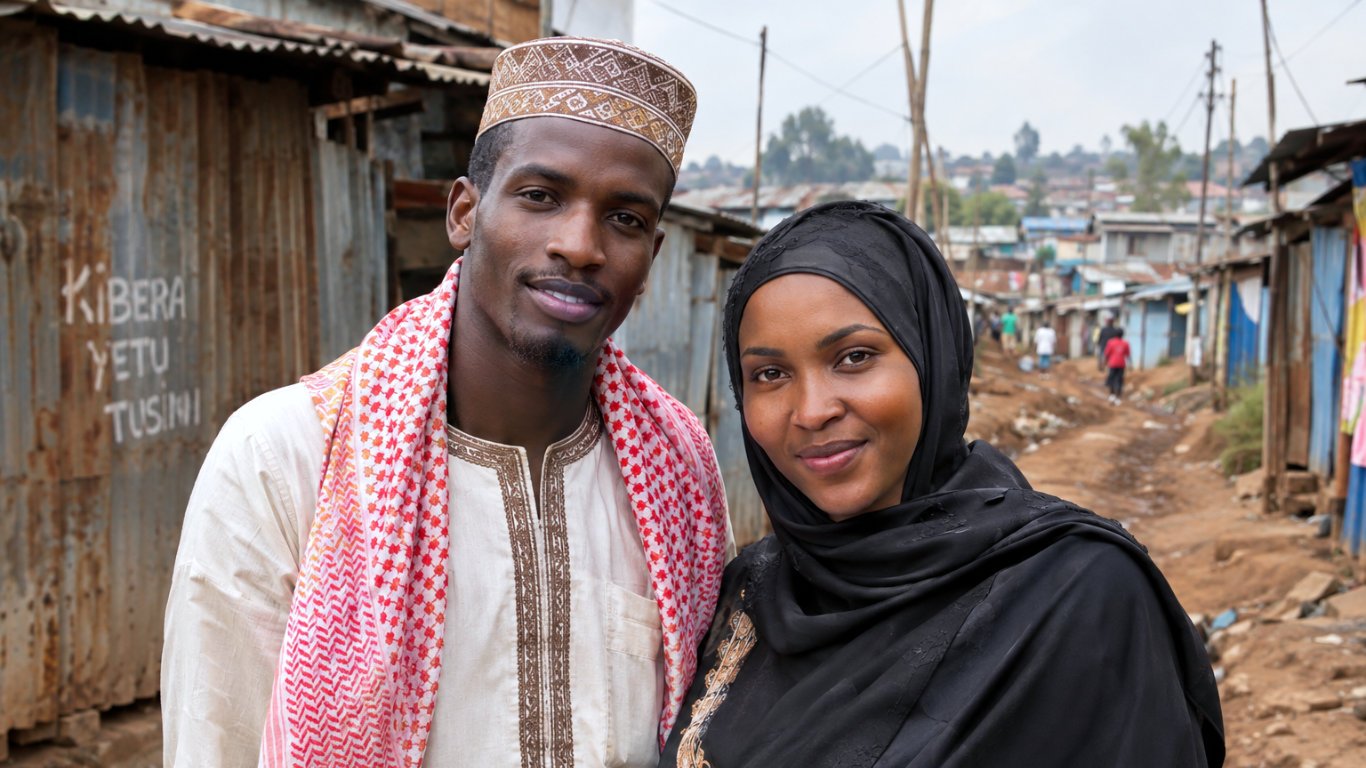
Before Kibera was a slum, it was a forest. The soldiers who cleared it and built their homes there named it Kibra — their word for forest. They believed it would be theirs forever. More than a century later, their descendants still live there. Not one of them holds a title deed.
Who They Are
The Nubi people of Kenya are not a tribe in the traditional sense. They are something rarer — a community forged from necessity, loyalty, and displacement, shaped not by ancestral land but by shared history.
Their origins lie in 19th-century Sudan, where the British recruited soldiers from multiple Sudanese ethnic groups to serve in colonial East Africa. These men — drawn from Dinka, Bari, Acholi, Madi, Kakwa, and other Sudanese peoples — held different beliefs, spoke different languages, and came from different homelands. But in the barracks, on the march, and in the years of settlement that followed, they became one people.
That people are the Nubi. Today, approximately 100,000 of them live in Kenya — predominantly in Kibera in Nairobi, but also in Mombasa, Kisumu, and Eldoret. A smaller but significant Nubi population lives in Uganda, particularly around the town of Bombo. They are, in the truest sense, a made-in-East-Africa people.
A History Worth Knowing
The story begins in the 1890s. The British Imperial East Africa Company — and later the colonial government — enlisted Sudanese soldiers to help administer the vast territories of what would become Uganda and Kenya. Among the key figures in this recruitment was Frederick Lugard, who led Sudanese troops through campaigns that cemented British control of the region.
These soldiers proved invaluable. When the campaigns ended and the colonial structure solidified, many chose to stay in East Africa rather than return to a Sudan increasingly in turmoil under Egyptian-Ottoman administration. They settled. They married local women. They raised families that belonged, legally, to no one.
In 1912, the British colonial government designated over 4,000 acres on the outskirts of Nairobi as a military reserve for these former Askari soldiers and their dependants. In 1917, the land was formally allocated to them. The Nubi cleared the forest, built their homes, and called the settlement Kibra. They were never given title deeds.
When Kenya gained independence in 1963, the new government inherited the colonial classification that had defined the Nubi as “detribalised natives” — a bureaucratic label that made them nobody’s people. The land they had occupied for decades remained government land on paper. The Nubi became squatters in the settlement they had founded.
The consequences compounded over generations. Without official recognition, many Nubi Kenyans struggled to obtain national identity cards. Without IDs, they could not vote, travel, enroll in university, marry officially, or access formal employment. A community that had fought for the British Empire found itself invisible in the independent nation it helped build.
The Nubi did not accept this quietly. Legal advocates took the fight to regional human rights bodies. In 2009 — for the first time — the national census formally recognised Nubians as a Kenyan ethnic group, ending decades of official erasure. That same year, the African Committee of Experts on the Rights and Welfare of the Child ruled that Kenya had violated the rights of Nubian children by denying them citizenship registration. Land rights victories followed. The forest that soldiers named over a century ago is, slowly and painfully, being recognised as theirs.
Language & Identity
Walk through Kibera and you will hear something you cannot hear anywhere else on earth — Kinubi, an Arabic-based creole language unique to the Nubi people of Kenya and Uganda.
Kinubi draws roughly 90% of its vocabulary from Arabic — specifically the Egyptian Arabic that spread through Sudan during the 19th century. But its grammar was reshaped by generations of contact with Swahili, Dholuo, Luganda, and the many languages spoken around Nubi settlements. The result is a language that sounds Arabic to the untrained ear but runs on its own internal logic.
Kinubi is not an import. It is something the Nubi built — born in the barracks and the settlements, carrying the fingerprints of every community that shaped them. Approximately 21,300 Kinubi speakers live in Kenya today, with the highest concentration in Kibera.
The very name Kibera is Nubian. Every time Nairobi residents say it, they are speaking Kinubi — without knowing it.
Culture, Customs & Celebrations
The Nubi are predominantly Sunni Muslim, and the Islamic calendar sets the rhythm of community life. Eid al-Fitr and Eid al-Adha are the year’s great celebrations — marked with communal prayers, elaborate feasts, and visiting between families that reinforces bonds built over generations. Moulid al-Nabi brings processions and public gatherings that spill into Kibera’s streets.
Nubi weddings are events of scale. A traditional wedding runs across multiple days, each with its own rituals, music, and gathering of extended family. Women dress in richly coloured fabrics with elaborate embroidery; men in flowing robes. Drumming begins early and continues late. In a community where belonging and memory are hard-won, these celebrations carry more than their obvious weight.
Music and dance are not optional extras — they are the thread that holds cultural memory in place. Traditional drums and stringed instruments feature in ceremonies, religious events, and communal gatherings. Elders transmit histories and values through song in ways that written records cannot replicate. Coming-of-age ceremonies mark the passage from youth to adulthood with communal blessing and collective witness.
Despite urbanisation and the economic pressure of life in one of Nairobi’s most densely populated areas, the Nubi have held these practices with remarkable consistency. Identity, for a community that spent decades without legal recognition, is not something given up lightly.
Livelihood & the Land
The original Nubi livelihood was military service. When that ended, the community turned to trade, crafts, and small enterprise — occupations that required no title deed and could be sustained within Kibera’s tight networks. Women have historically been central to this economic life, running market stalls, managing household enterprises, and practising crafts including weaving, beadwork, and embroidery.
Traditional Nubi beadwork is particularly distinctive — vibrant beads arranged into intricate patterns for jewellery with specific symbolic meaning. Basket weaving, metalwork, and leathercraft are also practised, producing both functional and decorative objects that carry the community’s artistic sensibility.
Today, the Nubi economic landscape is wider. Many access formal employment and professional careers, particularly since the citizenship recognition of 2009 opened doors that had been shut for generations. But Kibera’s constraints remain. The settlement that Nubi soldiers founded now houses hundreds of thousands of people — and the community that named it does not control it. That contradiction sits at the heart of every conversation about Nubi livelihoods, development, and the future.
Belief & Spiritual Life
Islam arrived in the Nubi community through its Sudanese military origins and has been the community’s primary faith ever since. Most Nubi Kenyans identify as Sunni Muslim. Mosques serve as centres of both worship and community life, and imams provide spiritual guidance while mediating in community matters.
The Nubi religious landscape also carries quieter traces of the diverse traditions that the community’s founding members brought from Sudan — an orientation toward ancestral respect, the significance of dreams, and a sense of the spiritual present in the natural world. These elements coexist with Islamic practice in ways that are rarely articulated as contradiction. They are simply lived.
Sufi influences have shaped certain strands of Nubi spiritual life, emphasising a direct, experiential relationship with the divine that sits alongside orthodox observance rather than against it.
Food & Drink
Nubi cuisine reflects both its Sudanese roots and its East African context. Aseeda — a thick porridge of sorghum or millet flour — is a staple, appearing at breakfast tables and celebratory spreads alike. Slow-cooked lamb and goat, seasoned with cumin, coriander, and ginger, are the dishes of feast days and family gatherings.
Lentil and chickpea stews make up the everyday table. Dates carry cultural and religious significance, particularly through Ramadan. Yogurt and fermented milk appear as sides and in recipes. The drink of the Nubi home is karkade — hibiscus tea, deep red and tart — valued for its colour and its cooling effect in Nairobi’s heat.
Communal eating is central to Nubi social life. Food at gatherings is rarely eaten alone. The act of sharing a meal is, for the Nubi people of Kenya, an act of community maintenance.
The Traveller’s Encounter
Kibera is not a destination for the detached gaze of a sightseeing tourist. But for a traveller genuinely curious about Nairobi’s layered human story, it is one of the most instructive places in the city — and the Nubi community is at its founding heart.
Several responsible community tourism initiatives operate in and around Kibera, offering guided walks led by local residents who tell the neighbourhood’s story from the inside. These visits call for cultural respect and a willingness to listen more than photograph. The Nubi people of Kenya are not a curiosity. They are a community with a specific, documentable history — and engaging with that history is what makes a visit meaningful.
The Nubian Heritage Cultural Festival, held periodically in Nairobi, provides a more structured opportunity to encounter Nubi music, dance, food, and craft in a celebratory setting. Check with Kenya Geographic for current dates and listings.
Visitors to Mombasa will also find Nubi communities in the Old Town area, where Swahili, Arab, and Nubi culture layer into one of Kenya’s most textured urban environments.
One essential note: if you are invited into a Nubi home, accept. The tradition of hospitality runs deep. Guests receive food, warmth, and time — not as performance, but as genuine welcome. Reciprocate accordingly.
Closing
The Nubi people of Kenya carry a story that resists easy categories. They are not ancient. They are not indigenous in the conventional sense. They came as soldiers, stayed as settlers, and built a neighbourhood that grew into one of Africa’s most discussed urban spaces — without ever being handed the papers to prove it was theirs.
What they built instead is harder to take away: a language spoken nowhere else on earth, a community that held together across a century of bureaucratic erasure, and a name — Kibera — that millions of people say every day without knowing they are speaking Nubian.
Explore more about Kenya’s communities at the Safiri Kenya blog on Kenya Geographic. And if you go to Kibera — go ready to listen.

Comment (0)