
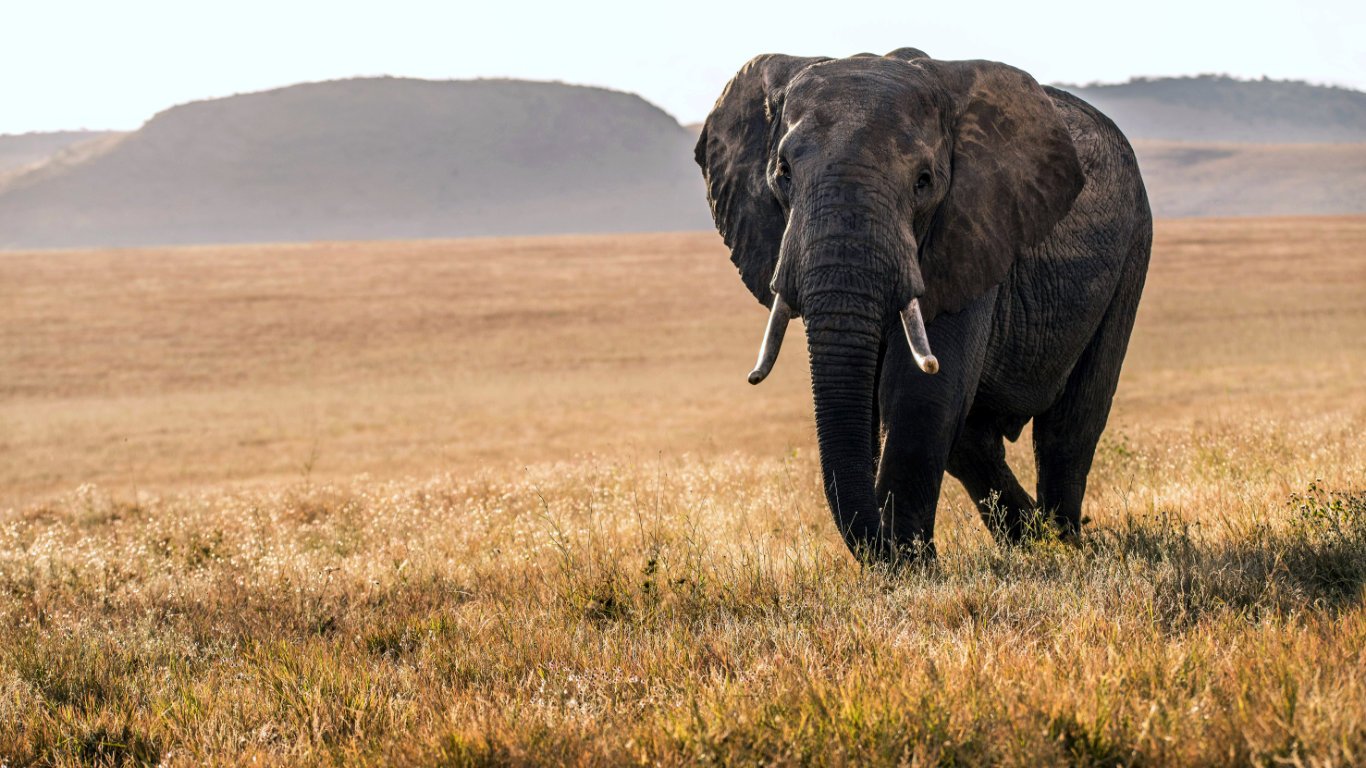
Safari guides across Kenya are fielding a question that would have sounded improbable a generation ago. Why do some elephants — especially females — have noticeably smaller tusks, or none at all?
The assumption, often repeated among visitors, is that elephants are hiding their tusks when humans approach. This belief is understandable but incorrect. Elephants cannot retract or conceal tusks. What travellers are observing is not behaviour designed to deceive but rather an evolutionary response to prolonged poaching pressure—one that unfolds quickly enough to be visible within a human lifetime.
The phenomenon raises a deeper question that now sits at the intersection of science, conservation, and tourism: why are elephants becoming tuskless, and what does the change mean for the future of Africa’s wildlife landscapes?
Debunking the Tusk-hiding Myth
Elephant tusks are elongated incisors embedded deep in the skull. There is no biological mechanism that allows elephants to hide or withdraw them. When tusks appear absent, it is either because the elephant is genuinely tuskless or because posture, vegetation, or viewing angle obscures them.
In areas with a history of poaching, elephants also display heightened vigilance. They avoid open ground, turn away from vehicles, and move more frequently at night. These behavioural shifts can reinforce the illusion of concealed tusks, but they do not explain the growing number of tuskless elephants now documented across Africa. The explanation lies in genetics, not deception.
Evolution Accelerated by Poaching
Historically, tusklessness was rare. Fewer than 5% of female elephants carried the trait, and it was extremely uncommon in males. That balance changed dramatically during the height of the ivory crisis between the 1970s and early 1990s.
In heavily poached populations, elephants with large tusks were selectively removed before they could reproduce. Those without tusks, or with smaller ones, were more likely to survive and pass on their genes. Over time, this skewed survival produced a measurable genetic shift.
Researchers at Gorongosa National Park in Mozambique discovered that over 50% of the adult females who survived the civil war were tuskless due to heavy targeting of elephants. Parts of Tanzania, Zambia, and Central Africa have recorded similar patterns.
This pace is striking. Evolution is typically measured over thousands of years. In this case, the change occurred over roughly 30 to 40 years. That speed reflects the intensity of human pressure, not natural environmental forces.
This conclusion is the most direct scientific answer to the question of why elephants are becoming tuskless: tusks became a fatal trait in landscapes dominated by poachers.
Why Females are More Affected
The genetic basis of tusklessness helps explain why the change is most visible among females. The trait is linked to sex chromosomes, allowing females to survive and reproduce without tusks, while males that inherit the same genetic configuration are far less likely to survive to birth.
As a result, the evolutionary response expresses itself primarily through females. Tuskless matriarchs now lead entire herds, subtly altering feeding strategies, digging behaviour, and landscape use. Such change is not adaptation in the sense of improvement. It is survival under sustained threat.
Kenya’s Contrasting Experience
Kenya offers an important counterpoint. By the late 1980s, rampant poaching had devastated the country’s elephant population. The turning point came with stronger legislation, the institutional strengthening of the Kenya Wildlife Service, and a deliberate shift toward tourism-funded conservation.
Today, while tusklessness exists in Kenya, it is far less prevalent than in regions where poaching remained unchecked. Amboseli and Tsavo still support elephants with large, intact tusks — a sign that reduced killing allows natural genetic balance to persist. Kenya’s experience demonstrates a crucial principle: when poaching pressure declines, the evolutionary forces driving tusk loss weaken.
The Economic Case We have Long Made
We have consistently argued that elephant conservation is not only an ecological or ethical imperative but also an economic one. In a previous analysis published on this platform, we demonstrated that living elephants generate far greater long-term value for Africa than dead ones.
The logic remains clear. Holding all factors constant, an elephant has a life expectancy of between 60 and 70 years. Kenya’s national parks charge conservation and entry fees that average several thousand shillings per visitor. Each year, millions of domestic and international travellers pass through this protected area.
When annual tourism revenue is projected across the lifetime of a single elephant, the figures become unequivocal. A living elephant generates recurring economic value through park fees, employment, hospitality, transport, and community enterprises. Ivory, by contrast, delivers a one-time payout, much of which exits the continent entirely through transnational criminal networks. From a purely economic perspective, it is more rational for Kenya — and for Africa — that the elephant lives.
Protection Beyond Fences
Electric fencing remains a useful tool in managing human–wildlife conflict, but modern anti-poaching efforts increasingly focus on intelligence and prevention.
Ranger units now rely on predictive patrol modelling, satellite tracking, and aerial surveillance. Whistleblowing has also become a critical weapon. WildLeaks, the world’s first whistleblowing platform dedicated to environmental crime, enables informants to expose trafficking networks anonymously and securely.
These approaches reduce poaching pressure at its source by targeting supply chains instead of responding after animal deaths. When killing declines, the evolutionary pressure driving tusklessness slows.
The Role You Play
Tourism actively participates in this story, rather than being a passive observer. Every park entry fee contributes directly to protection. Every occupied lodge room sustains livelihoods tied to conservation. Every visit reinforces the idea that wildlife has value beyond extraction.
Where communities benefit economically from elephants, tolerance for poaching collapses. Wildlife becomes an asset to protect, not a resource to liquidate.
This is why the question of why elephants are becoming tuskless matters to travellers. The answer reflects not only past choices but present ones.
A Future Still Within Reach
The shrinking tusks seen on safari today are a biological record of human pressure. They are neither a mystery nor a myth. Elephants are becoming tuskless because tusks have become dangerous to carry.
Whether that trend continues depends less on genetics than on governance, economics, and the choices made by those who live near elephants — and those who come to see them.

Comment (0)