
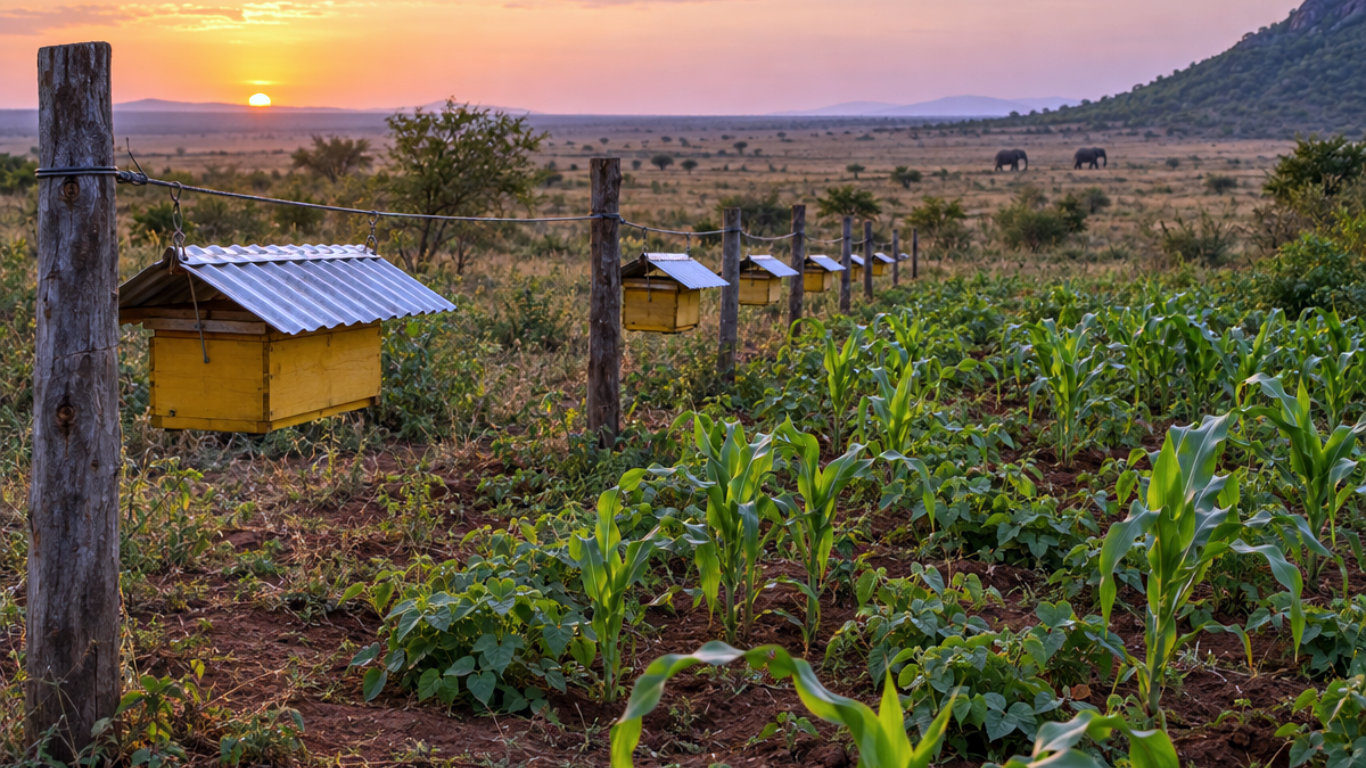
Between June 2012 and December 2020, researchers logged 3,999 elephant encounters, in 675 separate raid events, around the beehive-fenced farms of two villages at Sagalla, near Voi. Every recorded raid came at night, between 5 p.m. and 6 a.m. Until COVID-19 curbs in 2020, the team visited every raided farm next day. They checked each farmer’s account against footprints and dung.
The Question Our 2011 Story Left Open
In November 2011 Kenya Geographic reported a new way to keep elephants off small farms. Beehives hang on a wire between posts. An elephant that pushes through shakes the hives and lets the bees out. Our story described a two-year trial on 34 farms. It closed by asking readers whether anyone knew how far the project had gone.
The fullest answer came in October 2024. Lucy King of Save the Elephants and fourteen co-authors published nine years of Sagalla results in Conservation Science and Practice. The charity ran the study with the Kenya Wildlife Service, the Wildlife Research and Training Institute and the University of Oxford. The authors describe it as the longest known study of the method that Save the Elephants has carried out.
Lower Sagalla lies at the eastern foot of Sagalla Hill in Taita Taveta County, 3 km from the boundary of Tsavo East National Park. That boundary has no fence. Elephants cross it in both directions, and the farms on the other side grow maize, beans, watermelon and pumpkins.
Three in Four Elephants Turned Back
At Sagalla, beehive fences in Kenya turned back an average of 76 per cent of elephants each year. In the November to January growing season, when raids peak, the seasonal average rose to 86 per cent. An earlier analysis of the first ten farms had put the figure at 80 per cent.
The network grew with demand. It began in 2012 with 8 farms and 115 hives. By 2019 it covered 26 farms and 365 hives. Community meetings picked those farms from 110 mapped as front-line conflict sites. A live hive or a dummy hangs every 10 metres along each fence. The posts usually come free from the local Commiphora bush, whose cut stems take root and grow again.
Of the 3,999 approaches, 1,007 elephants broke through a fence. Another 343 took an easier route. Some fences had a gap of 10 to 40 metres at one end, so that live hives would not hang beside the house. Elephants found the gaps. Around the turn of 2019 the team closed them with a traditional alarm: tin cans on wire, with stones inside. Gap entries fell to 5 in 2019 and 11 in 2020.
In the trial, Save the Elephants donated the hives and wire, and each family gave the posts and the labour. The 2017 paper costed materials for a fence of 12 hives and 12 dummies. It came to USD 550 with Kenyan top-bar hives and USD 850 with Langstroth hives. It put a six-strand electric fence at no less than USD 9,000 a kilometre.
The Year the Hives Went Quiet
The 2017 drought at Sagalla showed that a beehive fence is only as strong as its bees. The short rains failed in November 2016. Only 288 mm of rain fell in 2017, against 691 mm on average in the study’s other years. By the 2017/18 growing season, hive occupation had dropped from over 60 per cent to 7.7 per cent. That season the fences still held. The authors suggest why: drought-stunted crops gave elephants little reason to push through.
The real test came a year later. Good rains returned in late 2018 and the crops grew well. The Kenya Wildlife Service was also driving illegal cattle out of the nearby parks. The authors think that may have pushed elephants out too. Between November 2018 and January 2019 the study logged 1,833 elephant encounters around the 26 farms. More than two-thirds of the hives still stood empty. The fences stopped 71.8 per cent of elephants that season, the lowest rate in the six peak seasons studied.
Honey tells the same story in kilograms. The fences gave 812 kg in 2014–2016, none in 2017, and 188 kg in 2018–2020, from more hives than before. Over the whole study, 1,000 kg of raw honey earned the 26 farmers about USD 2,250.
When the paper came out, Lucy King warned in Save the Elephants’ release that “increased habitat disturbance or more frequent droughts could reduce the effectiveness of this nature-based coexistence method.”
What Else Changed Around the Fences
The Sagalla study treats the beehive fence as one tool in a landscape that kept shifting around it. Work on the Standard Gauge Railway started in early 2014, and its barrier fences were complete by 2017. Wildlife underpasses went in, but elephants took time to learn where they were. Some stayed in the villages while they searched for a way back to the park.
The farmers tried other defences too. In 2019, 129 Sagalla farmers began growing sunflowers, a crop elephants are unlikely to eat. Raids fell over the next two years. The authors think the sunflowers may have helped, and that the quieter parks of the 2020 lockdown may have kept more elephants inside. They advise pairing beehive fences with methods that do not need rain. Their examples include unpalatable crops, smell- or light-based deterrents and trenches.
Each raid costs a family food it planted. One Sagalla farmer told researcher Sophia Weinmann, in an interview for her 2018 master’s thesis reported by Scientific American in 2021: “I planted about six kilos of green grams; they were all eaten.”
That pressure is unlikely to ease. Tsavo’s elephant counts cited in the paper rose from 12,573 in 2012 to 14,964 in 2020. Kenya’s human population grew 59.4 per cent between 2000 and 2020, the paper notes, citing the World Bank. More elephants living beside more people is exactly the situation beehive fences in Kenya were built for.
A Fence That Needs Rain
Fifteen years after our first report, the answer to our 2011 question is that beehive fences in Kenya work, have spread, and depend on rain nobody in Sagalla controls. By October 2024 Save the Elephants counted over 14,000 beehives hung against elephants at 97 sites in Africa and Asia. The Sagalla authors call the method a possible “sticking plaster” on the wider loss of space for elephants. They warn that worsening droughts could make it less reliable.
The unfenced line that lets Tsavo East’s elephants roam is the same line that leads them to Sagalla’s maize at night. For more on what human pressure does to elephants, read our report on why elephants are becoming tuskless. The full Sagalla study is free to read. If you are planning a trip to Tsavo East, see what SafariQuest lists around the park at kenyageographic.com.

Brilliant, this is a struggle across east Africa. Wildlife and human conflict. Uganda is experiencing similar struggles of wildlife and communities living next to national parks.
Hi 10 days Kenya Flying Safari. What are some of the innovative ways Uganda is dealing with the problem?