
In the Taita Hills in the early 1950s, anger kept inside the heart was treated as dangerous, above all between kin. The anthropologist Grace Harris, who did fieldwork there with Alfred Harris from 1950 to 1952, recorded how it was dealt with. A person took liquid into the mouth, sprayed it out, and called for the anger to leave. The act was called kutasa, and the Taita named their whole religion, Butasi, after it.
Who They Are
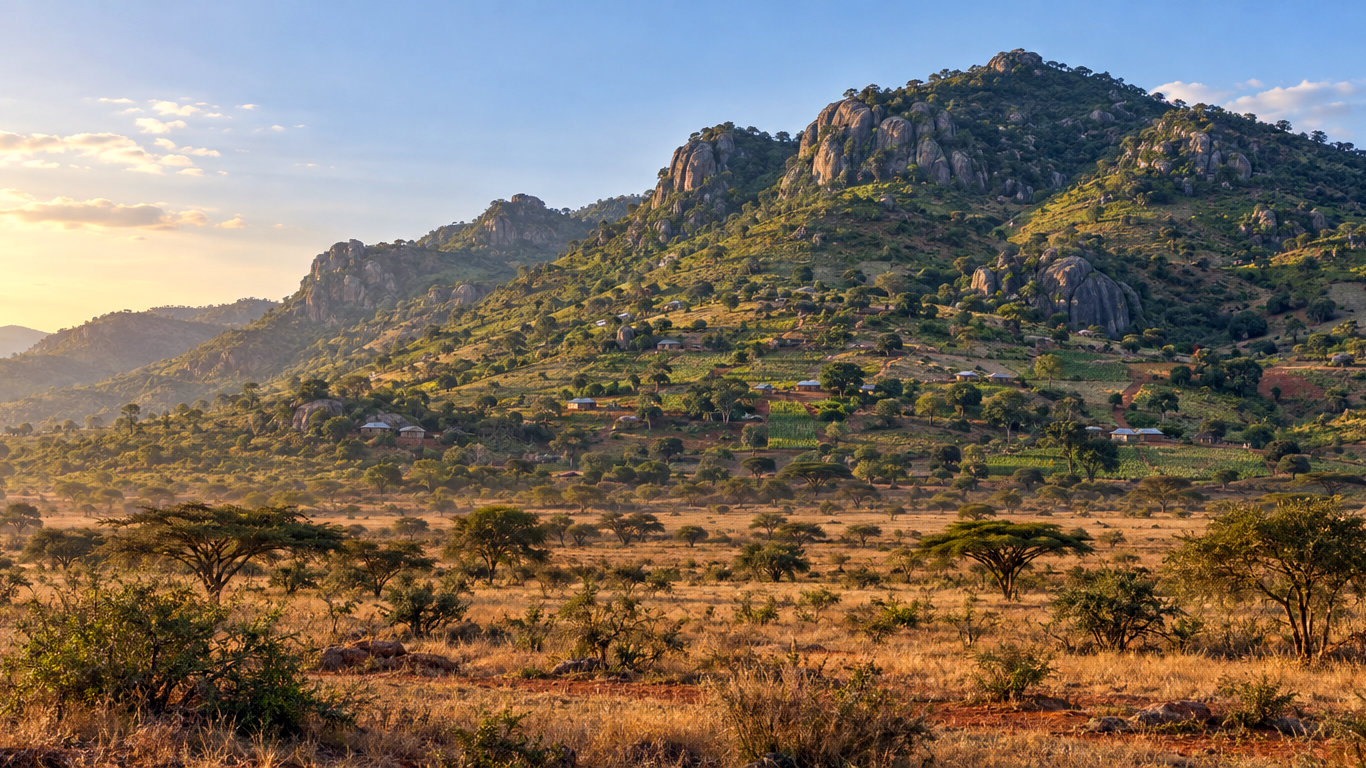
The Taita people of Kenya live in the Taita Hills of Taita-Taveta County, a cluster of massifs that rise out of the dry plains of Tsavo. There are three main massifs. Dawida is the largest and highest, reaching 2,228 metres at Vuria; Sagalla stands south of Voi town; and Kasigau sits apart near the Tanzanian border. Each has given its name to a section of the people: the Wadawida, the Wasagalla and the Wakasighau.
The 2019 census counted 344,415 Taita, up from 273,519 in 2009. They share a county with the Taveta, who are often mistaken for them. The two are separate communities with separate languages, and the 2019 census counted 26,590 Taveta.
The hills are also a refuge of another kind. Two forest birds found nowhere else, the Taita apalis and the Taita thrush, survive in their last patches of woodland, and both come up again below.
A History Worth Knowing
Before colonial rule there was no single Taita polity. Historians of the hills describe independent lineages, each holding its own territory and governing itself.
In the nineteenth century the caravan route from Mombasa to Kilimanjaro ran through Taru, Voi, Mwatate and Taveta, and a Taita leader named Mwangeka wa Malowa controlled part of it. Born in 1842 at Mwanda, according to the National Museums of Kenya, Mwangeka commanded fighters who guarded the route and levied taxes on coastal traders. Some traders signed agreements with him, called mtero.
The British, allied with the Sultan, moved against him. Paukwa, a Kenyan history archive, dates the expedition to 1892. Mwangeka’s forces were defeated at Mwashoti, and he was killed by a bullet during the retreat. The museum’s account says that one of his own men, Mbogholi wa Samaghembe, had been bribed into passing his tactics to the British. His second-in-command, Mnjala wa Ruma, gathered people in the caves of Vuria as a last line of defence until a ceasefire was mediated. The trade routes passed into British control.
Missions followed the same year. On 18 October 1892 a chief named Mbogholi gave 250 acres at Bura to a new Catholic mission, begun by priests travelling with the Holy Ghost Fathers, and its first service was celebrated on 30 September 1896. Its missionaries met strong resistance from people who wanted to keep their own beliefs, and the land they offered converts near the mission has fed land disputes ever since.
Colonial rule then pulled young men into wage work. Sisal plantations drew them in as labourers, and asbestos and graphite mines took others.
Language & Identity
The Taita speak Kidawida, also called Kitaita, a Bantu language listed as E.74 in the Guthrie classification. Dawida and Kasigau are its main dialects. Saghala, spoken on Sagalla, is closely related and is often described as close to Giriama on the coast.
Buried in the vocabulary is an older population. Linguists have identified loanwords in Dawida and Saghala from two extinct Southern Cushitic languages, sometimes called Taita Cushitic. Those borrowed words once carried lateral sounds foreign to Bantu, and speakers still pronounced them within living memory before Bantu sounds replaced them. The people who spoke those languages were absorbed into the Taita, and their words outlasted them.
Kitaveta, spoken by the Taveta on the plain to the west, is a different language. Its closest relative is Chasu, spoken in the Pare Mountains of Tanzania, which is one more reason the two communities should not be confused.
Culture, Customs & Celebrations
Harris made anger the centre of her account of Taita religion, and the Taita had made it the centre first. In her reading, kinship obligations and entitlements were bound up with a dangerous anger that festers in the heart. Kutasa dealt with it: the spraying of liquid from the mouth while calling for anger to be cast out. The ritual worked only if the person performing it was sincere, with what Harris called a “clean” and “cool” heart. Without that, it failed.
Women had a second affliction to manage. Saka was the Taita name for a spirit attack that came on, as Harris described it, sometimes without any obvious warning, with convulsive movements. Its cure was a dance, and Harris argued that the saka dance turned the attack on its head.
Spirit dancing was still active in the hills in 2003, when the researcher Brandon Judge documented several pepo healing groups in the Taita Hills. Illness was attributed to pepo spirits, and the cure was drumming, song and dance. Dancers moved anticlockwise, and drummers tried one song after another until the patient responded by falling down shaking. The song that worked was the right one. One group, Mbara Mghondi, kept time with a wooden board called a mugongo and sticks called mlingo instead of drums. Another, Kwaya Mbanga, met on Sundays at a cave near Mwanda. Children began watching at about seven and joined in at about nine.
Livelihood & the Land
The Taita people of Kenya farm the hills, mostly on rain. Maize, beans, sorghum, cowpeas, pigeon peas and green grams are the main crops, according to a 2022 analysis by the researcher Victoria Ng’eno for The Elephant. Ng’eno found food insecurity felt most in the drier Taita part of the county. Only 14 per cent of Taita’s land is under irrigation, she reported, while Taveta irrigates up to 53 per cent. In her words, “Taveta has been Taita’s key food supplier.” In Harris’s time bananas were a man’s cash crop rather than a staple.
On the lower slopes the farms meet the elephants of Tsavo East. At Sagalla, a nine-year study led by Lucy King of Save the Elephants recorded 3,999 elephants approaching farms. Fences strung with beehives turned back an average of 76 per cent of them a year, until drought in 2017 left most of the hives unoccupied.
Higher up, the forest is almost gone. BirdLife International reported in 2020 that about 98 per cent of the Taita Hills’ original forest has been destroyed. What remains is fragmented, and it holds the Taita apalis, a forest bird with about 150 individuals left in the wild, and the Taita thrush, both critically endangered.
Belief & Spiritual Life
The Taita kept the skulls of their dead in rock shelters and caves. Harris called these shrines ngomenyi. After a body had been buried for about a year it was exhumed and the skull taken to the shrine. The popular account adds a detail. A sharp stone was placed under the neck at burial so that the skull would come away cleanly, as the Sheldrick Wildlife Trust and our own 2018 post on the Taita skull caves both describe.
Accounts disagree on two points. Harris wrote that skulls were kept for the men of large lineages, and that in her time the shrines were not themselves sites of ritual practice. Later popular accounts say the Wadawida kept only the skulls of elderly men, while the Wasagalla also kept those of women and children. They also describe elders going to the caves to appeal to the ancestors in famine, drought and disease. By the 1950s, interviews gathered by the historian Bruce Bravman suggest, the shrines were already contested or neglected as schooling, wage work and Christianity spread.
Most Taita today are Christian. The skulls remain, and so does the respect. In February 2025 the Kenya News Agency reported that elders perform rites before outsiders may enter the caves. The same report said the National Museums of Kenya wants the skull caves and the county’s First World War sites considered for UNESCO World Heritage status.
Food & Drink
The everyday plate in the hills is ugali, which the Taita call mswara, eaten with greens: cowpea leaves, cassava leaves and wild greens such as mgagani. Pure combines pounded maize with beans. Kimanga mashes beans with banana, pumpkin, sweet potato or cassava, and comes out at celebrations alongside mbangara, a local beer brewed from maize chaff. Meat was once dried on the rocks, a method called mdanda, though most people now eat it fresh.
The Traveller’s Encounter
The skull caves near Wundanyi are the best-known place to meet Taita history. Discover Pwani, a portal for Kenya’s coastal counties, gives the entry fee as KES 300 and opening hours of 8 a.m. to 5 p.m. Visits are arranged through the local community, usually with a Taita elder. The Kenya News Agency reports that visitors enter barefoot and must not look back as they leave. Photography may be restricted, so ask the elder before you lift a camera. At Sagalla, the Sheldrick Wildlife Trust reports that visitor income from the caves supports conservation on the hill.
For the hills themselves, Vuria is the summit, and the remaining forest patches are where birders look for the Taita apalis and the Taita thrush. With about 150 apalis left, go with a local guide and keep to the paths.
Travelling with the Taita people of Kenya in mind changes what a Tsavo trip looks like. The hills rising out of the plains are someone’s home, farm and burial ground, and the elephants that cross between park and farm meet beehive fences on the way.
A Cool Heart Was the Whole Ritual
Harris stressed something easy to miss in a description of spraying liquid and calling out words. What made kutasa work was not the performance. It was whether the person meant it. A ritual done with “inner reservations” achieved nothing. In Harris’s account anger between kin was dangerous, so whether a person truly meant it mattered to everyone around them.
Harris was careful to call her book a picture of Taita religion as it stood in the middle of the twentieth century, and much of what she saw has changed. The idea at its centre is still worth carrying up the hill: that a grievance held in silence does damage, and that putting it down takes more than words. Explore more of Kenya’s communities on the Safiri Kenya blog at Kenya Geographic.

Comment (0)