
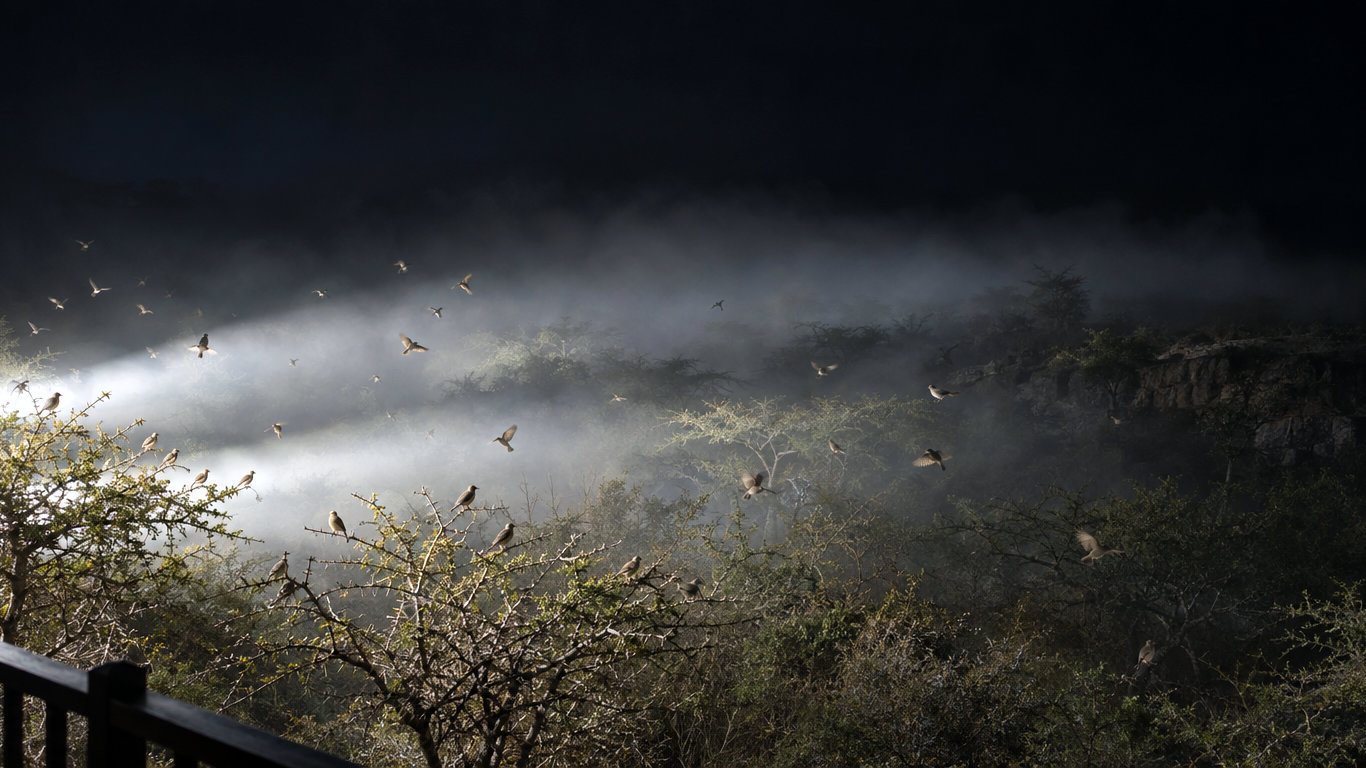
In December 1969, seven months after Ngulia Safari Lodge opened above the Tsavo West escarpment, Alec Forbes-Watson found its lights crowded with migrant birds from Europe and Asia. He carried specimens back to the National Museum in Nairobi. Scores of casualties were picked up beneath one floodlit white wall, and its 1.5-kilowatt lamp had to come down. The birds still come down at Ngulia, and a team of ringers still meets them.
What Happens at Ngulia on a Misty Night
Ngulia bird ringing is the yearly catching and ringing of Palaearctic songbirds that land at the floodlights of Ngulia Safari Lodge, in Tsavo West National Park, on moonless, misty nights. The southward migration crosses Ngulia from late October to early January. The ringing itself runs for about two weeks around a new moon in November or December. The ringers have described the pattern themselves.
Their review, by David Pearson, Graeme Backhurst and Colin Jackson, appeared in the journal Scopus in 2014. In their account, birds came down when the cloud over the floodlit area sank to bush-top height, and only on moonless nights. A small partial moon greatly reduced the arrivals and a near-full moon usually ended them. Heavy rain could still bring some birds in under a large moon.
Three species dominate: the Marsh Warbler, the Thrush Nightingale and the Common Whitethroat. They breed anywhere from western Europe to Siberia and Pakistan. Most ringed birds found again elsewhere had covered between 3,000 and 7,000 kilometres. Some winter as far south as Botswana and South Africa. Nature Kenya puts the total ringed at Ngulia from 1969 to 2020 at 597,694 Palaearctic birds of 72 species. One Marsh Warbler ringed here in November 2024 turned up in Sweden seven months later, 7,133 kilometres away.
A Night and a Dawn at the Lights
On a good night the first birds appear about an hour after sunset. The Scopus review places the first few outside the lodge from about 19:15. Tens or hundreds reach the lights from 20:00, and Eurasian Rollers, nightjars and Harlequin Quails often come in with them. The passage overhead is mostly quiet. Even so, the ringers write that “the eerie atmosphere is often broken by soft high pitched flight calls”, most often a faint tseep they assume comes from the Thrush Nightingale.
In the review’s account, night netting rarely began before 21:30, and the reason is stated plainly: “game viewing by tourists usually has to take precedence during the evening.” The lodge’s open-air restaurant still looks over its floodlit water holes. If the cloud lifts before about two in the morning, most grounded birds leave again.
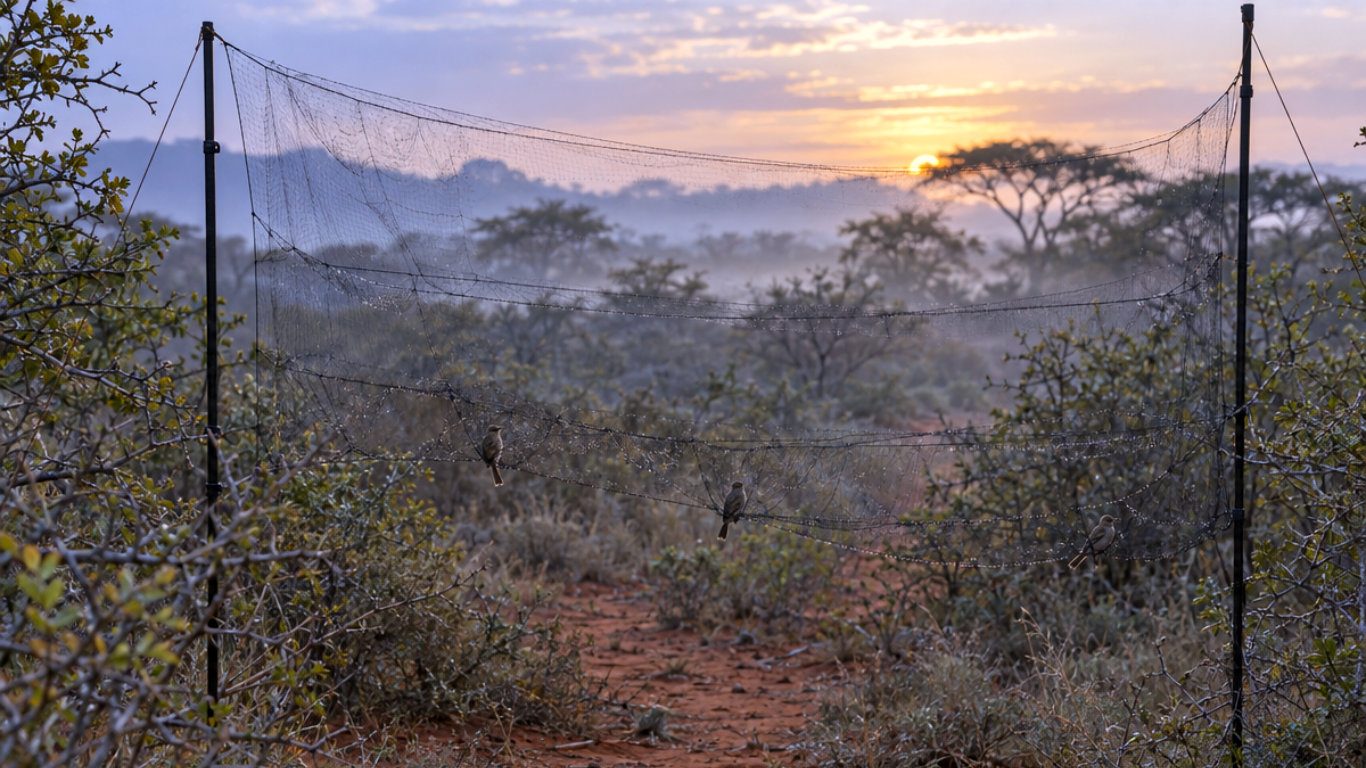
The bush nets below the lodge open at about 05:45, in half-light. Thrush Nightingales scatter first and Marsh Warblers about twenty minutes later. In the review’s figures, some 70 per cent of the daytime catch of the three main species is in hand by 07:00. Usually fewer than one bird in a hundred is caught again later the same season. The authors read that as an almost complete turnover of birds from one day to the next.
Reading the 2026 Moon and Mist
In 2026 the mist record favours the December dark period, because Ngulia’s nights grow mistier as the season runs on. The Scopus review counts 1,149 nights manned between 1972 and 2012. Up to 15 November, 36 per cent of them had mist. From 16 November to 15 December the share rose to 64 per cent, and after that to 74 per cent.
New moons fall on 9 November and 9 December this year, with a full moon on 24 November (timeanddate.com, Nairobi times). So the November dark window sits mostly in the less misty early season. The passage peak, which the review puts around the end of November, falls close to the full moon whichever window you choose. The December window lands in the mistier stretch and still inside the mid-November to mid-December period when, the review says, most birds have been ringed. Thrush Nightingale passage declines from mid-December, so expect a different mix of species than in November.
None of this is a promise. The 2025 session ran from 11 to 25 November because of an early new moon, and its first week had almost no mist. Nature Kenya still reported one night on which 1,706 birds were ringed, 1,117 of them Common Whitethroats.
When we checked on 2 October 2026, Nature Kenya had not published dates for this year. The review describes Ngulia bird ringing as timed to the November–December new-moon periods, and Nature Kenya tied the early 2025 start to the moon. The 2021 session was planned for 30 November to 10 December. The 2024 session ran from 24 November to 6 December.
Booking a Room, or a Notebook
Watching Ngulia bird ringing means a night at Ngulia Safari Lodge, because the falls happen after the park gates close. The lodge has 52 rooms on the Ndawe escarpment and is run by Kenya Safari Lodges & Hotels. In 2021, Nature Kenya said its members “are welcome to book a stay at Ngulia Lodge during that time and observe the ringing”. They could also volunteer to scribe, writing the notes for the ringers. Confirm both for 2026 before paying a deposit.
The Kenya Wildlife Service puts Mtito Andei Gate 240 kilometres from Nairobi and 250 from Mombasa. The Standard Gauge Railway stops at Mtito Andei station. Gates open at 06:00 and close at 18:00 unless you are staying overnight. KWS lists adult entry to Tsavo West at KES 1,000 in its East Africa citizen category, KES 1,350 for Kenya residents and USD 80 for non-residents.
The Nets Open at 05:45
Ngulia bird ringing rewards the guest who stays up for the mist and rises for the nets. In 2026 the mist record points to December. Ask Nature Kenya for the season’s dates first. Then build the trip around them. Our older guide to things to do in Tsavo West covers the daylight hours, and SafariQuest can handle the nights either side.

Comment (0)