
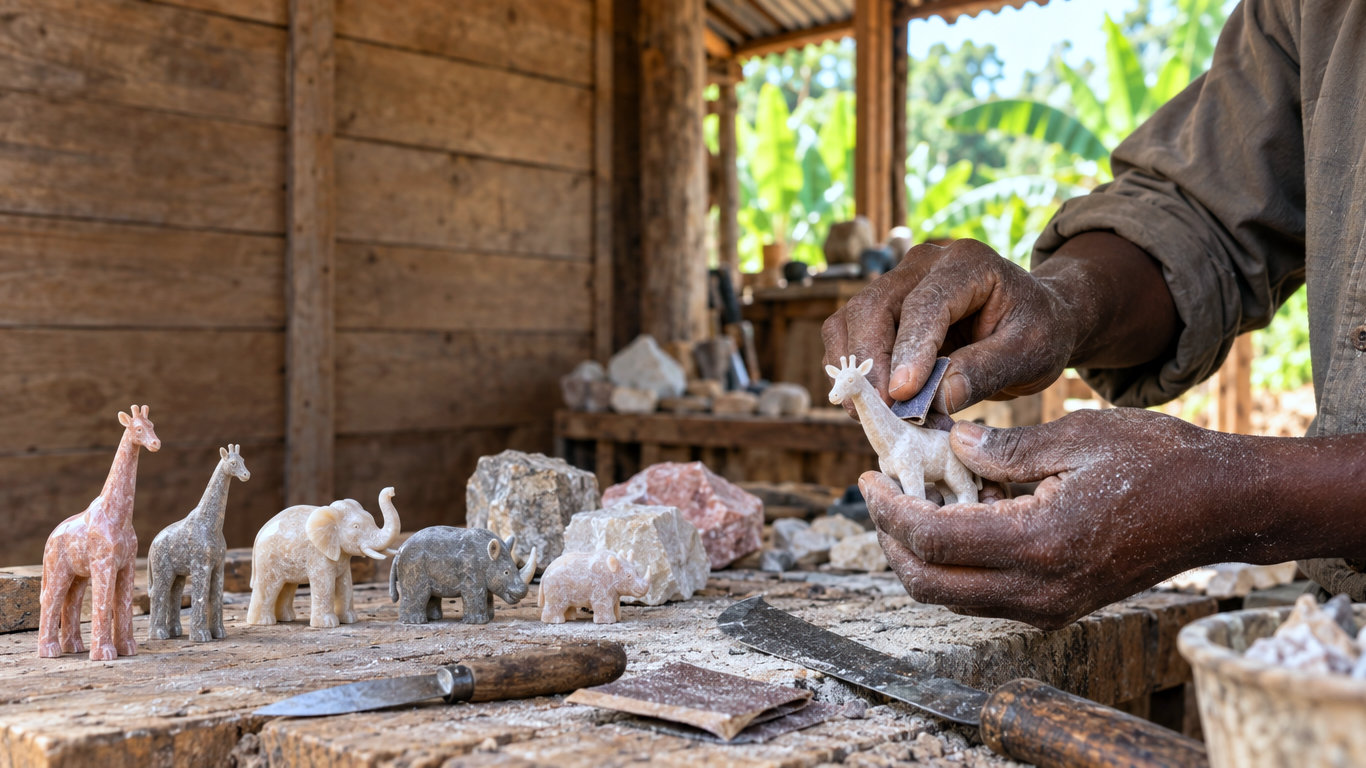
In Tabaka, a two-inch soapstone giraffe leaves the carver’s hands for KES 200. Dismas Araka recorded what happens next in a 2025 study for the journal of the Kenya National Commission for UNESCO. Abroad, the same carving resells for USD 20, about ten times as much. The stone itself travels the world under the name of the people who dig it out of their farms, and that name is Kisii.
Who They Are
The Kisii people of Kenya call themselves Abagusii and their language Ekegusii. Kisii is the Swahili name, which the colonial administration adopted. A single person is Omogusii at home and Mkisii in Swahili.
They live in the highlands of Kisii and Nyamira counties in western Kenya, between Lake Victoria and the Tanzanian border. Their neighbours include the Luo and the Kipsigis. The 2019 census counted 2,703,235 Kisii, up from 2,205,669 in 2009.
Their highlands are high, wet and fertile. The land rises from about 1,190 metres in the north-west to 2,130 metres, according to the anthropologist N. Thomas Hakansson in the Encyclopedia of World Cultures. Rain falls at between 1,500 and 2,000 millimetres a year, and farmers can work between 70 and 80 per cent of the ground. Britannica describes it as one of the most densely populated parts of Kenya. Gusii society runs on patrilineal clans, and a person must marry outside their own. Every marriage therefore ties two clans together.
A History Worth Knowing
The Gusii probably reached their present highlands from the Mount Elgon region about 500 years ago, in Britannica’s estimate. Their own oral tradition reaches much further, to a homeland called Misri. Historians disagree about what that name points to. Some read it as a borrowing from biblical Egypt and look for a dry country north of Mount Elgon instead. Others argue the link to Egypt deserves to be taken seriously.
Colonial rule arrived by force. Geoffrey Northcote, a young British officer, came to Kenya in 1904 and accompanied a punitive expedition into Gusii country in 1905. In 1907 he returned to run the new Kisii station, and that December he began collecting hut tax.
On 18 January 1908, during a raid on cattle camps in Kitutu, a warrior named Otenyo Nyamaterere speared Northcote in the shoulder at Manga. Northcote survived and called for reinforcements. The reprisals that followed took more than 8,000 head of livestock from Kitutu, and accounts put the number killed at more than 160. Sources do not all agree on the date. Most give 18 January 1908, but the National Museums of Kenya’s online exhibit tells the story inside the 1905 expedition.
Otenyo was executed by firing squad and beheaded. The British arrested his aunt Moraa Ng’iti, a seer who had raised him, and held her at Kisii police station; she died in 1929. Elders have long said the British took Otenyo’s head to London. In February 2026 James Matundura, chairman of the Abagusii Cultural Development Council, asked the British government to return it for burial. The report of that demand did not name any museum as holding it.
Armed resistance in Gusiiland ended after the First World War, Hakansson writes. The Catholic mission opened in 1911, and the Seventh-day Adventists followed in 1913. By the 1950s these hills were growing coffee and tea for sale.
Language & Identity
Ekegusii is a Bantu language, classed as JE.42 in the Guthrie system that linguists use to sort Bantu languages. It belongs to a small group of related languages that share unusual ways of marking tense. The group includes Kuria and, in northern Tanzania, Ngurimi and Simbiti.
The language has two main varieties, Rogoro and Maate, and most of what separates them is vocabulary. A cat is ekemoni in one and ekebusi in the other. Ekegusii has seven vowels and uses vowel length to tell words apart, so bóra means to miss and bóóra means to say.
Ekegusii is the home language of a community that numbered 2.2 million at the 2009 census, which puts it among Kenya’s larger languages. It also marks the Kisii out on the map. Their two largest neighbours, the Luo and the Kipsigis, speak Nilotic languages from an entirely different family.
Culture, Customs & Celebrations
The sound most associated with Gusii music is the obokano, an eight-stringed bass lyre that can stand six feet tall, the largest lyre in Kenya. Its soundbox is a wooden bowl covered with cow or goat skin, and the player tunes it by adjusting each string’s tension on the crossbar. The obokano usually accompanies singing; played alone, it tends to open a song. Men have traditionally played it, while women play the ekonu drum and rattles at circumcision celebrations.
Initiation marks the passage to adulthood. Boys have traditionally been circumcised as children, at ages that sources put between about eight and twelve, in ceremonies held towards the end of the year. A period of seclusion follows, during which older initiates teach them the rules of shame, chinsoni, and of respect, ogosika. Girls’ initiation historically involved genital cutting. Kenya outlawed the practice under the Prohibition of Female Genital Mutilation Act, 2011. On 17 March 2021 the High Court in Nairobi upheld that law.
Bride-wealth makes a marriage, once paid in cattle and now in livestock and money, and every marriage must cross clan lines. Families traditionally negotiated through intermediaries called chisigani. A mentor, the omoimari, stayed on after the wedding to support the couple.
Livelihood & the Land
Farming is the base of the Gusii economy. Finger millet was the old staple until maize replaced it in the twentieth century. Tea, coffee and pyrethrum are the cash crops, and bananas, cassava and sorghum grow alongside them.
Soapstone is the trade that carries the Kisii name abroad, and it centres on Tabaka in South Mugirango. Miners buy stone from the farm owners whose land it lies under and dig it from open pits by hand. One Tabaka miner, Reuben Nyamao, told the Nation that miners pay about KES 1,000 for 400 kilograms of stone. Moving it to a workshop costs roughly 400 more. Carvers rough out a shape with machetes and knives, then sand, dye and polish it. The stone ranges from light pink through creamy white to grey.
From 1966 the market for Tabaka carvings spread to North America, South America, Europe, Asia and Australia, Araka records. Even so, the price chain leaves the people at the start of it with the smallest share. Middlemen buy unfinished pieces at KES 50 and pay a finisher KES 10 to complete each one. The work carries real risk as well. Carvers in Araka’s study reported bronchitis and asthma from the dust, and he cites a 2022 Nation report of a collapse at the Nyabigena quarry that killed two miners.
Belief & Spiritual Life
Gusii religion held that one God created the world but did not intervene directly in human affairs, Hakansson writes. God is widely called Engoro, and also Nyasae, a word borrowed from Dholuo.
Misfortune had causes closer to home. Ancestor spirits, ebirecha, could bring illness or loss if the living neglected them. Diviners called abaragori, usually women, identified which spirit was displeased and what would settle it. Gusii memory also keeps its prophets. Sakawa, who died around 1902, is remembered for foretelling the coming of white men, and Moraa Ng’iti for warning of what colonial rule would cost.
Most Kisii today are Christian. The four largest churches are the Roman Catholic, the Seventh-day Adventist, the Swedish Lutheran and the Pentecostal Assemblies of God. Hakansson describes a Christianity still mixed with belief in the ancestors, and many families keep both.
Food & Drink
The centre of a Gusii meal is obokima, a stiff dough made by stirring flour into boiling water until it holds its shape. Cooks made it from finger millet or sorghum before maize took over. People eat it with leafy greens such as chinsaga and, traditionally, with sour milk. Bananas, which Britannica lists among the community’s main food crops, round out a table built on what these wet hills grow.
The Traveller’s Encounter
Tabaka, about 24 kilometres from Kisii town, is where to see Kisii stone at its source. Curio shops line the main road, and visitors can walk out to the active quarries and watch carvers at work in the sheds around the town.
The single most useful thing a visitor can do is buy directly from the people who carve. Self-help groups such as Smolart work in Tabaka. Araka’s figures show why buying from carvers matters: their KES 200 is the smallest number in the chain, and a direct sale is where a visitor can change it.
Quarry walls are unstable, as the Nyabigena collapse showed, so stay out of the pits. Keep clear of the fine dust in carving sheds, and ask before photographing anyone at work.
For the history, the Manga escarpment in Kitutu is where Otenyo speared Northcote and where, by Ukombozi Review’s account, elders later buried his body. Kisii town makes the natural base for both. Travelling with the Kisii people of Kenya in mind changes what you notice on the road to Tabaka: the farms of one of the country’s most crowded highlands, and the pits behind a craft sold from Australia to the Americas.
A Bird at UNESCO, a Giraffe at 200 Shillings
Elkana Ong’esa came from Tabaka and carved the same stone the town still digs. His Enyamuchera, an abstract soapstone bird 142 centimetres high that UNESCO’s catalogue calls the Bird of Peace, carved between 1976 and 1978, has stood at the Miollis entrance of UNESCO’s headquarters in Paris since Kenya donated it in 1980. When he died in November 2024, The Star recalled an interview he gave AFP the year before. African art had shaped Western art heavily, he said, yet the market had left it behind.
The Kisii people of Kenya are asking, in more than one way, for something to come home. Elders want a warrior’s head returned for burial. Carvers want a fairer share of what their stone earns abroad. Neither has been settled. A visitor can do nothing about the first, and something small but real about the second, every time a carving is bought in Tabaka from the hands that made it. Explore more of Kenya’s communities on the Safiri Kenya blog at Kenya Geographic.

Comment (0)